Namibia is located in southwest Africa. It is a large and mainly arid country sharing borders with Angola to the north, Botswana to the east, South Africa to the south and, in the Caprivi Strip, a narrow panhandle of Namibian territory jutting from the northeast corner of the country, with Zambia and Zimbabwe.  To the west is 1280km (795 miles) of some of the most desolate and lonely coastline in the world. The port of Walvis Bay, situated roughly halfway down Namibia’s coast, was returned by South Africa to Namibian jurisdiction in February 1994. Along its entire length, the vast shifting sand dunes of the Namib Desert spread inland for 80 to 130km (50 to 80 miles). To the west is 1280km (795 miles) of some of the most desolate and lonely coastline in the world. The port of Walvis Bay, situated roughly halfway down Namibia’s coast, was returned by South Africa to Namibian jurisdiction in February 1994. Along its entire length, the vast shifting sand dunes of the Namib Desert spread inland for 80 to 130km (50 to 80 miles). In the interior, the escarpment of a north–south plateau slopes away to the east and north into the vast interior sand basin of the Kalahari. In the far northwest, the 66,000 sq km (25,500 sq miles) of the Kaokoland mountains run along the coast, while further inland lies the Etosha Pan (a dried-out saline lake), surrounded by grasslands and bush which support a large and varied wildlife. The Etosha National Park & Game Reserve is the third largest in Africa, owes its unique landscape to the Etosha Pan, a vast shallow depression edged by waterholes to the south which guarantee rewarding game viewing. Once governed by Germany and South Africa, Namibia has been independent since 1990. Germanic influence can still be found in the country's well-maintained towns, roads and rest camps. Namibia is peaceful and more prosperous than many nearby countries because of its productive mining, farming, fishing and tourism industries.
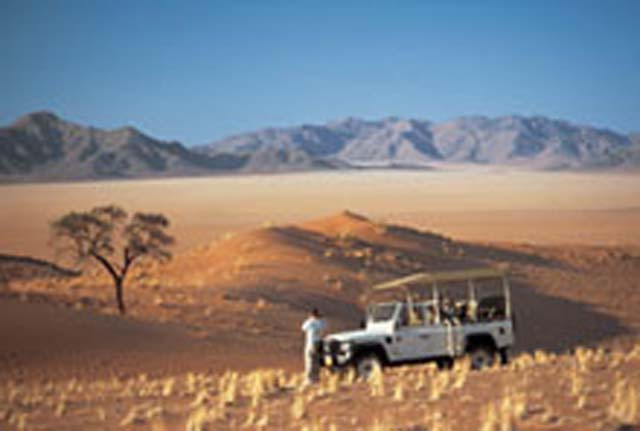
Essentially a desert country, Namibia offers contrasting landscapes. The Namib Desert is a vast swathe of high dunes and desolate plains with an awe-inspiring sense of space. The thorn bush savannah and rugged mountains of the central plateau give way to the majestic Fish River Canyon in the south. In the north of the country, landscapes range from the dense bush and open plains of the great Etosha Pan, to woodland savannah and lush vegetation. Etosha National Park, the third largest in Africa, owes its unique landscape to the Etosha Pan, a vast shallow depression edged by waterholes to the south which guarantee rewarding game viewing. |